Browse Exhibits (64 total)
"Naked Lunch": the First Fifty Years

This exhibition celebrates the 50th anniversary of William S. Burroughs's novel Naked Lunch and Columbia University's extensive holdings of rare books and original manuscripts related to the novel's creation, composition, and editing. The exhibition includes Burroughs's original manuscript of Naked Lunch, and correspondence from Lucien Carr, Allen Ginsberg, and Jack Kerouac.
"Our Tools of Learning" : George Arthur Plimpton's Gifts to Columbia University
George Arthur Plimpton (1855-1936) was a publisher, author, and book collector, born in Walpole, Massachusetts. He assembled a remarkable collection of manuscripts and books illuminating the history of education. Describing his sixty years of collecting in the preface to his first book, The Education of Shakespeare, Plimpton wrote: "It has been my privilege to get together the manuscripts and books which are more or less responsible for our present civilization, because they are the books from which the youth of many centuries have received their education." The collection was given to Columbia in 1936.
Drawn exclusively from the Plimpton Collection, the exhibition includes manuscripts and books from medieval times through the early 20th century, including many of the manuscripts and books that were used to illustrate Plimpton's The Education of Shakespeare and The Education of Chaucer, and David Eugene Smith's Rara Arithmetica. Additional sections of the exhibition deal with handwriting and education for women, two of Plimpton's particular interests.
For More Information
For more information, visit The Rare Book & Manuscript Library at Columbia University Libraries.
"The Unwritten History": Alexander Gumby's African America

About the Exhibit
More than 150 scrapbooks comprise the core of the Alexander Gumby Collection of Negroiana, part of the Rare Book & Manuscript Library at Columbia University. Together, these volumes contain a diverse array of manuscripts, photographs, pamphlets, artwork, clippings, and ephemera primarily related to African-American history from the nineteenth to the mid-twentieth centuries. At the time of its creation from about 1900 to 1950, the collection's curator, L.S. Alexander Gumby, explained that this "History of the Negro in Scrapbook . . . could well be called 'The Unwritten History'" of the United States, due to the lack of general scholarly attention paid to African Americans by contemporary historians.
This exhibition introduces visitors to the remarkable Gumby and situates his life and project in the context of the Harlem Renaissance--his acquaintances included luminaries such as Richard Bruce Nugent, Countee Cullen, and Langston Hughes--and in relation to other contemporary pioneers of African-American history such as Arthur Schomburg and Carter G. Woodson. Showcasing pages from nearly fifty of Gumby's scrapbooks, it highlights both the rare and the seemingly mundane items that Gumby argued could combine to document an otherwise forgotten history of the United States and its African American contributors.
Exhibit Structure
"The Unwritten History" seeks to provide insight into both the intellectual nature and context of Gumby's project as well as its content and execution. It is therefore structured in a manner that emphasizes the curatorial authority that Alexander Gumby exercised in both his selection of subject matter and his use of the scrapbook form. Beginning with an introductory section ("The Great God Gumby") that provides background information about Gumby and the origin of his scrapbook project, the exhibit proceeds to Gumby's Peers, a section which describes contemporary efforts similar to Gumby's and that in part inspired his own.
Following are five sections that provide a broad overview of the types of items that Gumby spent his life collecting. Gumby's Past presents his interest in identifying and preserving items--particularly those related to the African diaspora--from or about a history that he worried might otherwise be lost. Though contemporary to Gumby's own life, the items in Gumby's People and Gumby's Institutions similarly represent the types of noteworthy individuals and organizations of the first half of the twentieth century whose careers Gumby avidly followed and which he felt needed to be documented so that future generations would be able to write their histories. In contrast to these people-focused sections, Gumby's Events includes pages related to specific occurrences that Gumby felt deserved documentation, while the pages in Gumby's Culture showcase his attempt to capture in a condensed form some long-developing themes of popular discourse.
A Note on the Images
Each image that appears in this exhibit is a reproduction of a full page from one of Alexander Gumby's scrapbooks. Wherever possible, each image appears with a caption that lists the page number and title of the scrapbook from which it has been reproduced. Larger views and additional bibliographic information can be accessed by clicking on most images in the exhibit.
#LoveInAction
“Never forget that justice is what love looks like in public.” Cornel West
This site was created in order to capture and celebrate the tremendous amount of work that Union Theological Seminary students, alumni/ae, and faculty have done to demonstrate #LoveInAction. All Union students, alumni/ae, and faculty are invited and encouraged to contribute their original digital content, such as images, video, audio, and/or writings that they feel help to document #LoveInAction.
Below you can view all of the items that have been contributed. Please check back frequently as this site is updated as contributions are made!
If you have any questions about the project please contact Carolyn V. Bratnober, Public Services Librarian at Burke Library: cb3161@columbia.edu or (212) 851-5609.
1968: Columbia in Crisis


The occupation of five buildings in April 1968 marked a sea change in the relationships among Columbia University administration, its faculty, its student body, and its neighbors. Featuring documents, photographs, and audio from the University Archives, 1968: Columbia in Crisis examines the the causes, actions, and aftermath of a protest that captivated the campus, the nation, and the world.
This online exhibition is based upon a physical exhibition of the same name which was on display in the Rare Book and Manuscript Library from March 17 to August 1, 2008.
Unless otherwise noted, all images and documents are from collections found in the Columbia University Archives.
1968: The Global Revolutions

“1968: The Global Revolutions” is a digital exhibition drawing on a wide range of archives held in the collections at Columbia University's Rare Book & Manuscript Library. From Hanoi to Harlem, Czechoslovakia to China, Memphis to Paris, the yearlong crises of 1968 rocked world communities with an epoch-making series of political explosions. In late April 1968, “The Revolution” came to campus at Columbia University. “1968: The Global Revolutions” traces the connections between those worldwide upheavals, linking them together to demonstrate how many local and national movements looked to peers and comrades in other countries, campuses, and communities. The exhibition was timed to coincide with the fiftieth anniversary of those events. It appeared in the spring of 2018 in the Kempner Gallery of the Rare Book & Manuscript Library at Columbia University. Funding for the exhibition and related programming was provided by the Office of the Provost, the Department of History, and the Herbert H. Lehman Center for American History.
A Church is Born: Church of South India Inauguration

“A Church Is Born” depicts the 1947 inauguration of the unified Church of South India.
This film and commentary, originally produced by the India Committee of the Foreign Missions Conference of North America, provides a brief overview of the history of Christian Missions to India, explains the appeal for unity amongst Protestant denominations in India, and shows the inauguration of the Church of South India.
The collection is housed at the Burke Library at Union Theological Seminary, Columbia University Libraries.
A.J. Downing & His Legacy

Andrew Jackson Downing is known as the “father” of the American architectural pattern book. Not an architect, nor a trained artist, Downing was an avid reader of British horticulture publications, some of which illustrated ideal houses for the country. Through the British publications, Downing saw both how books could transmit design ideas in words and pictures, and how modest houses with Romantic Revival design gestures could form the basis for an improved American housing for its middle classes, particularly in rural and small town settings. To further that end, he published three important works: A treatise on the theory and practice of landscape gardening (first issued in 1841); Cottage residences (first published 1842); and The architecture of country houses (first issued in 1852). Each ran to several editions, and remained in print for some thirty years. Earlier architectural design books showed buildings in stiff and barren elevation drawings, where in Downing’s images, the house, landscape, and inhabitants become part of one happy, desirable image. This exhibition, originally mounted in Avery Library’s Classics Reading Room to celebrate the 200th anniversary of his birth, showcases several editions of Downing’s publications and those of his many successors. It offers a glimpse into the world of mid-19th century architectural publishing in the United States and reveals how Downing’s distillation of design ideas came to influence American housing for half a century.
Arthur Mitchell: Harlem's Ballet Trailblazer

Arthur Mitchell: Harlem’s Ballet Trailblazer celebrates the extraordinary career and legacy of the New York City Ballet’s first African-American star and the founder and longtime director of the Dance Theatre of Harlem. Born in Harlem, Mitchell studied at the High School of Performing Arts, danced on Broadway and with several modern dance groups. He discovered ballet at the Katherine Dunham School, worked tirelessly with Karel Shook, a brilliant teacher who became his mentor and later co-director of DTH, and in 1955 was invited by NYCB’s artistic director George Balanchine to join the internationally acclaimed company. Poet Marianne Moore called him a “slim dragon-fly too rapid for the eye to cage,” and this mobility, coupled with his winning stage personality, made him an audience favorite. Balanchine created several great roles for him, including the pas de deux in Agon (1957) and Puck in A Midsummer Night’s Dream (1962).
Although Mitchell attended integrated schools, he encountered racism throughout the dance world of the 1950s and 1960s. On Broadway he danced in all-black musicals, in ballet with all-white companies. On network television he could not partner a white ballerina, even if he did so routinely on stage. Only modern dance in the early 1950s was integrated, and Mitchell forged a happy partnership with Mary Hinkson, a black Martha Graham dancer who performed with him on television and abroad.
In 1968, galvanized by the assassination of Dr. Martin Luther King, Jr., he began teaching at Harlem School of the Arts and, with Karel Shook, formed what became the Dance Theatre of Harlem. Like The Studio Museum and Negro Ensemble Company, DTH was forged in the crucible of the Civil Rights and Black Arts Movements. “Whenever I danced,” Mitchell once said, “I danced for my mom and my people.” DTH was a company of dancers on a mission, intent on proving that African Americans could dance classical ballet. Harlem was their home, but they also belonged to New York City and to the world. Above all, they were a community that believed that making art was also an act of justice. Performing Giselle set in antebellum Louisiana, Firebird in a mythical African rainforest, or Dougla among the mixed African and Indian population of Trinidad, DTH danced its own vision of the African diaspora.
Arthur Mitchell: Harlem’s Ballet Trailblazer pays tribute to a lifetime of creative achievement, while also celebrating the artists – white as well as black – who helped bring to life Mitchell’s vision of a more just world through dance.
This website, created in tandem with the exhibition Arthur Mitchell: Harlem’s Ballet Trailblazer, on display at the Wallach Art Gallery from January 12 to March 11, 2018, highlights material from the Arthur Mitchell Collection, Rare Book & Manuscript Library, Columbia University. It also includes commissioned essays, timelines, links to publicly available sources, and other resources in addition to material from the physical exhibition. Please share this website with friends, students, and colleagues, using it to explore the rich histories behind Arthur Mitchell’s career and the Dance Theatre of Harlem, which celebrates its fiftieth anniversary in 2019, and encourage new scholarship about African Americans and ballet.
Exhibition Curator
Lynn Garafola
Image credit: Michael D. Harris, Aspirations + Inspiration (detail), 1985, limited edition print 7/30, Arthur Mitchell Collection, Rare Book & Manuscript Library.
Avery’s Architectural Ephemera Collections

Avery Classics is home to one of the largest special collections of rare architectural materials in the world. In addition to books, manuscripts, and photographs, the department includes a significant collection of ephemera. This exhibit describes some of the brochures, pamphlets, advertising materials, postcards, and other forms of architectural ephemera within Avery Classics.
Some of the items featured in this exhibition have been digitized and links for online access have been included when available. All items shown are available for in-person consultation in Avery Classics. To schedule a research appointment, send an email to avery-classics@libraries.cul.columbia.edu.
For more information about our department or collection, please visit the Avery Classics Homepage.
Avery’s Architectural Novelties

Architectural Novelties at the Avery Architectural and Fine Arts Library
Avery Classics is one of the largest collections of rare architectural books in the world. Among its thousands of volumes are the first printed book on architecture–Leon Battista Alberti's De re aedificatoria of 1485–and over one hundred editions of Vitruvius, who wrote the lone surviving classical text on the subject. In addition to printed books, the collection also includes manuscripts, photographs, and broadsides that reflect the library's scope.
However, certain items in Avery Classics have distinctive forms that fall outside all these categories. Such items, which we will call Architectural Novelties, are best explained in images. This exhibition highlights a selection of items from the Avery Classics collection that are both comprehensive and eccentric in their treatment of architecture.
Barney Rosset and China

The images in this exhibition come from the Barney Rosset Papers held by the Rare Book and Manuscript Library at Columbia University.
Kunming Municipal Museum in Kunming City, Yunan, China, mounted an exhibition of these images "Publisher-hero as Combat Photographer in China," which opened on February 20, 2014.
Image selection and captioning was done by exhibit co-curators Bob Bergin, Karla Nielsen, and Astrid Rosset. The text and arrangement of the online exhibit was created by Margarita Castroman, Jessica Hallock, and Karla Nielsen.
Butler 75: Butler Library's 75th Anniversary, 1934-2009

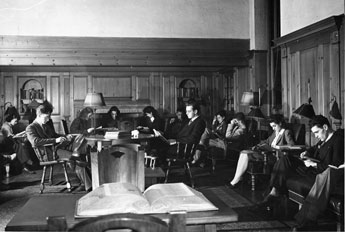 In celebration of the 75th anniversary of the building of Butler Library, an exhibit of more than 100 photographs decorate the bulletin board display on the third floor of Butler Library. The photographs span the decades and showcase the excavation and rise of South Hall (as it was originally named), design details throughout the building, reading rooms, services such as research assistance and student activities -- which include sleeping as well as studying!
Special Feature: Your Stories
As part of our 75th anniversary celebration, we are gathering and sharing stories from alumni and students like you about discovery, personal reward, and fun. If you have a story or just a thought to share, we would love to read it.
Caste, Ambedkar, and Contemporary India

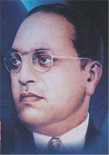
Dr. B. R. Ambedkar
This exhibit complements the conference, "Caste and Contemporary India," taking place on October 16th and 17th, 2009, at Columbia University in honor of alumnus Dr. B. R. Ambedkar. The conference is co-sponsored by the South Asia Institute, the Center for Human Rights Documentation & Research, the Center for the Study of Ethnicity and Race, the Department of Middle East and Asian Languages and Cultures, the Institute for Religion, Culture and Public Life, and the Institute for Social and Economic Research and Policy.
The exhibit features a sampling of resources on issues of caste with reference to gender, politics, constitutional history, and religion in contemporary India. We highlight resources available in the South Asian Studies Collections at Columbia University Libraries and reference research carried out by our faculty and students on these themes. The exhibit includes limited views of copyrighted works, many full-text works freely available online, and links to subscription resources available only to Columbia faculty, students, and staff. Many of the subscription resources may be available in other research libraries. We also feature links to the extensive network of non-governmental organizations dedicated to issues of caste and Dalit rights.
When talking about caste in the context of contemporary India one cannot but talk about Ambedkar. Born into an untouchable family Dr. Bhimrao Ramji Ambedkar (14 April 1891-6 December 1956) also known as Babasaheb, endured many social and financial difficulties in his lifetime. Fortunately, royal patronage helped him pursue his studies abroad at Columbia University and the London School of Economics. He was the chief architect of the Constitution of India. Fighting against all forms of social injustice, he became the champion of Dalit rights in India. There are several documents highlighting Ambedkar's experience at Columbia University in the exhibit.
Charles A. Platt's Italian Garden Photographs

In 1892, Charles A. Platt traveled to Italy with his brother, William, to view Italian Renaissance villas and gardens. Many of the photographs he took were used to illustrate his Italian Gardens (Harper & Brothers, 1894). Additional images were included in the 1993 reissue of Italian Gardens, with an overview by Keith Morgan (Sagapress/Timber Press). The remainder of these images remained unpublished.
The images displayed in this exhibition have been photographed from the original 8" x 10" glass plate negatives held in the Charles A. Platt Architectural Records and Papers Collection, Drawings & Archives Collection, Avery Architectural & Fine Arts Library.
Bookmark this URL as:
http://www.columbia.edu/cgi-bin/cul/resolve?lweb0180
Children's Drawings of the Spanish Civil War

During the Spanish Civil War (1936-1939) children were evacuated from the war zones to "colonies" in the war-free areas of Spain and in the south of France. Drawings by these children – most between the ages of seven and fourteen – were collected from throughout Spain in a concerted effort by the Spanish Board of Education and the Carnegie Institute of Spain. A large group was assembled by Joseph A. Weissberger in early 1938 and brought to the United States on behalf of the Spanish Child Welfare Association for the American Friends Service Committee (AFSC – "Quakers"). They were used by the AFSC as a means to publicize the plight of the children and collect funds for more evacuations and other assistance. Over 850 of these drawings have been identified in a variety of locations. Columbia received the 153 images presented here in 1938 through a bequest and they became part of the collections of the Avery Architectural and Fine Arts Library in 1977.
Angela Giral, former director of the Avery Library, championed the project of bringing these drawings to the Web and reaching out to those who may have been affected by these mass relocations. She explains her personal connection to these drawings:
I, too, was evacuated from the war zone about the same time that these drawings were made in the children’s colonies. I had the good fortune of being evacuated by my family and taken to my grandparents in Algiers. Barely three years old at the time, if I made any drawings they were not preserved. What I remember from later years is stories about my grandfather’s obsession with trying to make me laugh ... I was a perennially sad child.
Joseph Weissberger, in his introduction to "And they still draw pictures!" calls these drawings "autobiographic pages of un-kept diaries." Some of these children never saw their parents again, others went back to Spain at the end of the war, some went into exile, like myself, and grew up in far away lands. My hope is that many are still alive and willing to add some pages to these incomplete autobiographies, bringing them up to date. With the permission of those who write I would like to post the messages in this same web-page. In any case, the information thus assembled will be kept as an electronic component of Avery’s archive on the "Spanish children’s drawings" and may one day also be deposited in the archives on the Civil War now being assembled in Spain.
If you are one of those children, or a relative that can provide some updated information on the life or whereabouts of any of them, I would greatly appreciate hearing from you.Angela Giral, Former Director
Avery Architectural and Fine Arts Library
Columbia University, MC-0301
1172 Amsterdam Avenue,
New York, NY, 10027
giral@columbia.edu
Choosing Sides: Right-Wing Icons in the Group Research Records
 |
|
This 1964 issue of Human Events featured an article by Barry Goldwater attacking Group Research. |
About the Exhibit
The Group Research, Inc. Records, housed in the Rare Book & Manuscript Library at Columbia University, comprise a rich resource documenting the organizations, people, and campaigns of conservative activists in the United States from the early-1960s to the mid-1990s. Drawn from that collection, the items in this exhibit highlight the important role that illustrators, cartoonists and designers played in the dissemination of conservative points of view during this formative period for modern US conservative ideology.
Whether concerned with the strength of the federal government, the power of communists, the public and personal roles of religion, the freedom of private enterprise, the validity of taxation or the social effects of civil rights legislation, each artist whose work is displayed here illustrated his or her particular issue of concern in a way that both advocated a political position on the subject and implied that any alternative stance was un-American. Though not every issue displayed here was shared by every artist or organization represented, all of the items demonstrate such a propensity to divide the righteous from the pernicious. Collectively, these works demonstrate the central role that the ideology of being “with us or against us” played in US conservative activism long before George W. Bush used the concept as a defining feature of his “War on Terror.”
Exhibit Structure
The form of the exhibit highlights this theme of division. Two brief essays in the Introduction section describe the ideological motivations of both conservative artists and the organization, Group Research, Inc. that collected their work. Picturing Partners showcases images of sympathetic people that conservative artists felt were either in need of protection by or further support from conservative campaigns and activists. Envisioning Enemies reveals the darker half of America that these activists feared: the individuals, groups and organizations that threaten true patriots. The final section, Portraying Patriotism, demonstrates how conservative activists manipulated politically neutral images such as the US flag or the Statue of Liberty to make partisan arguments about US values and the future of the country.
Comics in the Curriculum

Graphic novels and comics are, for the most part, a recent addition to the Columbia University Libraries collections, and this addition reflects both the variety and sophistication of the medium as well as critical and academic interest.
The “graphic novel” is a format—narrative conveyed through sequential art—not a genre, and as such these works encompass a myriad of genres and artistic styles, as you can see in the images here.
While these materials can be read for entertainment—as can much of the literature in the libraries’ collections—they can also be incorporated into research and curricula to illustrate a variety of themes. The examples that follow merely scratch the surface.
Each theme begins with a familiar image from traditional art, one likely to be used to illustrate that theme in teaching or scholarship. Each image is matched with selections from graphic novels that can be used in a similar way.
For more information about Butler’s graphic novels collection, contact Karen Green at klg19@columbia.edu
Acknowledgements: Many thanks to Jeremy Dauber, Richard Bulliet, Janet Gertz, David Ortiz, Erik Sommer, Emily Holmes, Alexis Hagadorn, Jen Rutner, and Jim Hanley’s Universe.
Construction and Evolution of Union Theological Seminary Campus

This digital exhibit features images from a small collection of photographs documenting the construction of Union Theological Seminary located in the Morningside Heights neighborhood of New York City. The third location for the Seminary, the buildings were constructed from 1908-1910.
The collection is housed at the Burke Library at Union Theological Seminary, Columbia University in the City of New York.
Core Curriculum: Contemporary Civilization

Columbia University’s commitment to the Core Curriculum extends to the University Libraries' special collections. Columbia University Libraries preserve and provide access to important editions of, and in some cases autograph manuscripts by, many of the authors taught in the Core Curriculum. Additionally, the collections include subsequent editions, translations, and adaptations, which demonstrate the transmission and reception of these works across centuries and attest to their continuing importance.
These online exhibitions were created as part of an Association of Research Libraries CEP Fellowship Summer 2011 based in Columbia University's Rare Book and Manuscript Library. The RBML staff welcomes Columbia undergraduates who would like to follow up on a potential research question related to any of these items to consult them in person. Instructions for using the library's collections can be found here. See also the exhibit on the Core Curriculum's course on Literature Humanities.