
Precedents of Jewish Studies at Columbia
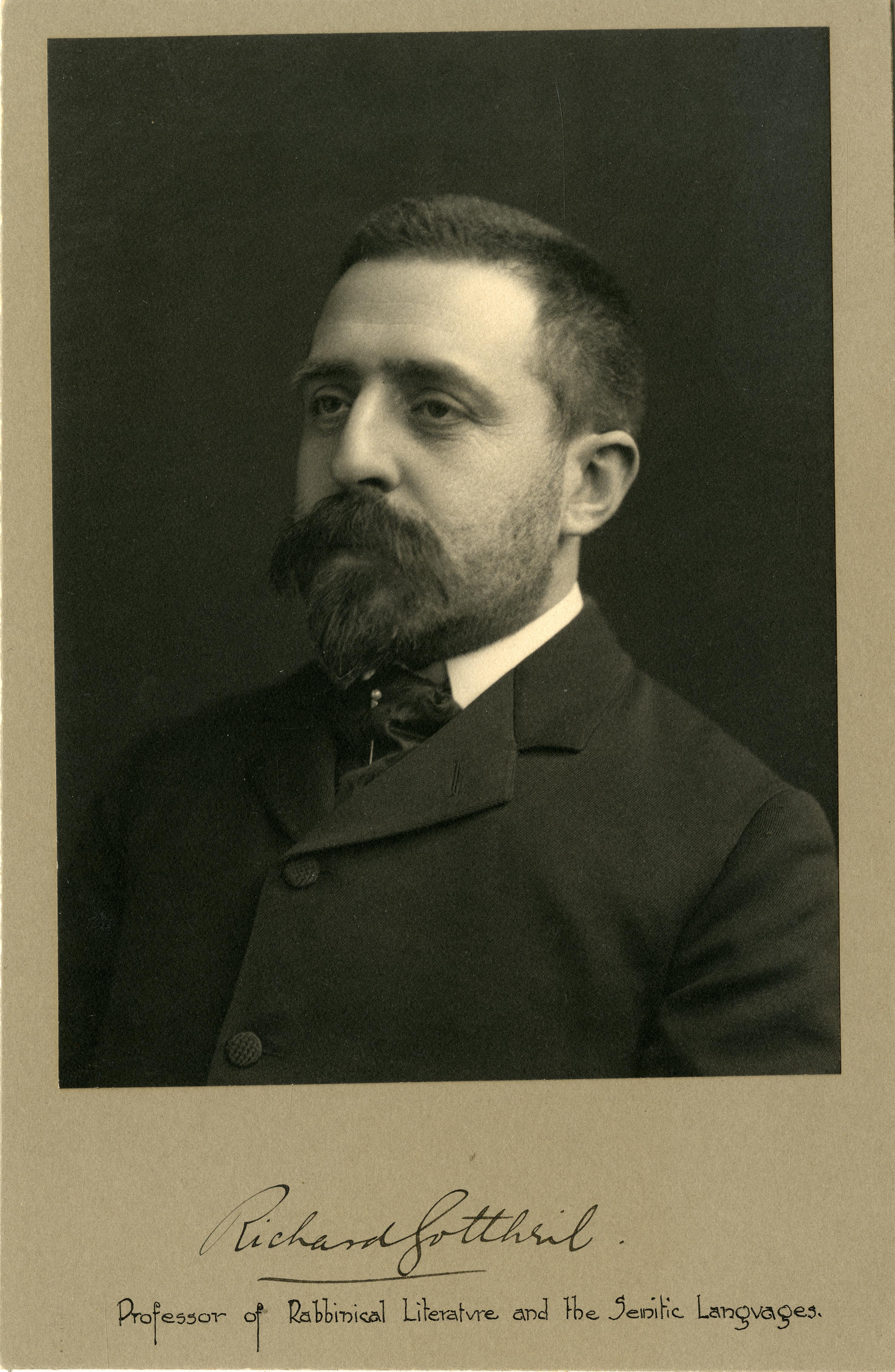
Richard James Horatio Gottheil
- Collection
- Historical Photograph Collection, Box 9, Gottheil, Richard, University Archives
Like many universities of its kind, Columbia demonstrated an interest in “Oriental” studies as early as the mid-18th century. Samuel Johnson, the founder of Columbia, taught Hebrew as one of three required languages (alongside Latin and Greek), from 1754, and Rev. Johann C. Kunze was established as the Professor of Oriental Languages in the 1780s. Among the languages Kunze taught were Hebrew, Arabic, and Syriac. After a long lapse, the professorship was revived in 1830 by Samuel H. Turner. His classes and lectures were poorly attended and once again Hebrew instruction faded into obscurity at Columbia. The 1880s brought in a renewed interest in the academic study of ancient Jewish texts. At the recommendation of Rabbi Gustav Gottheil of Temple Emanu-el, Columbia established a “Chair of Rabbinical Literature” in 1887, hiring Gottheil’s son, Richard J.H. Gottheil, to assume the professorship. Gottheil taught courses in a range of Semitic languages, including, but not limited to, Biblical Hebrew, Rabbinical Hebrew, Assyrian, Arabic, and Syriac. Drawing from German-Jewish scholarly traditions, Gottheil brought a rigorous but modernized approach to Jewish texts, treating them as historical and literary artifacts rather than solely religious documents. His teaching, which also included Aramaic and comparative Semitics, attracted a small but growing group of students.
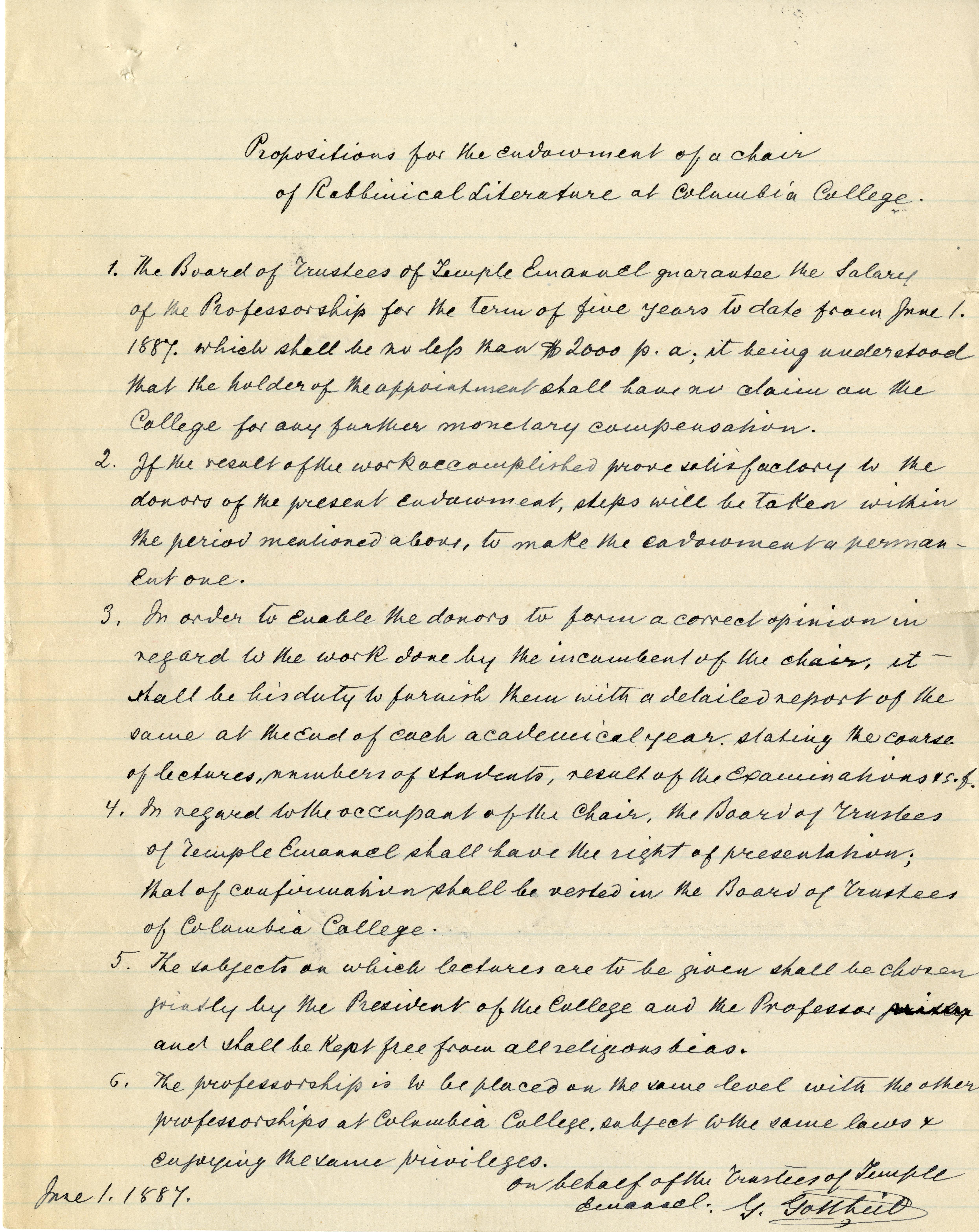
Letter from Temple Emanu-el to Seth Low
Gustav Gottheil to Morgan Dix, et al (May 1887), Report of Select Committee re: communication from Dr. G. Gottheil proposing chair of Hebrew Literature in College
- Collection
- Columbia College Papers, Box 59, University Archives
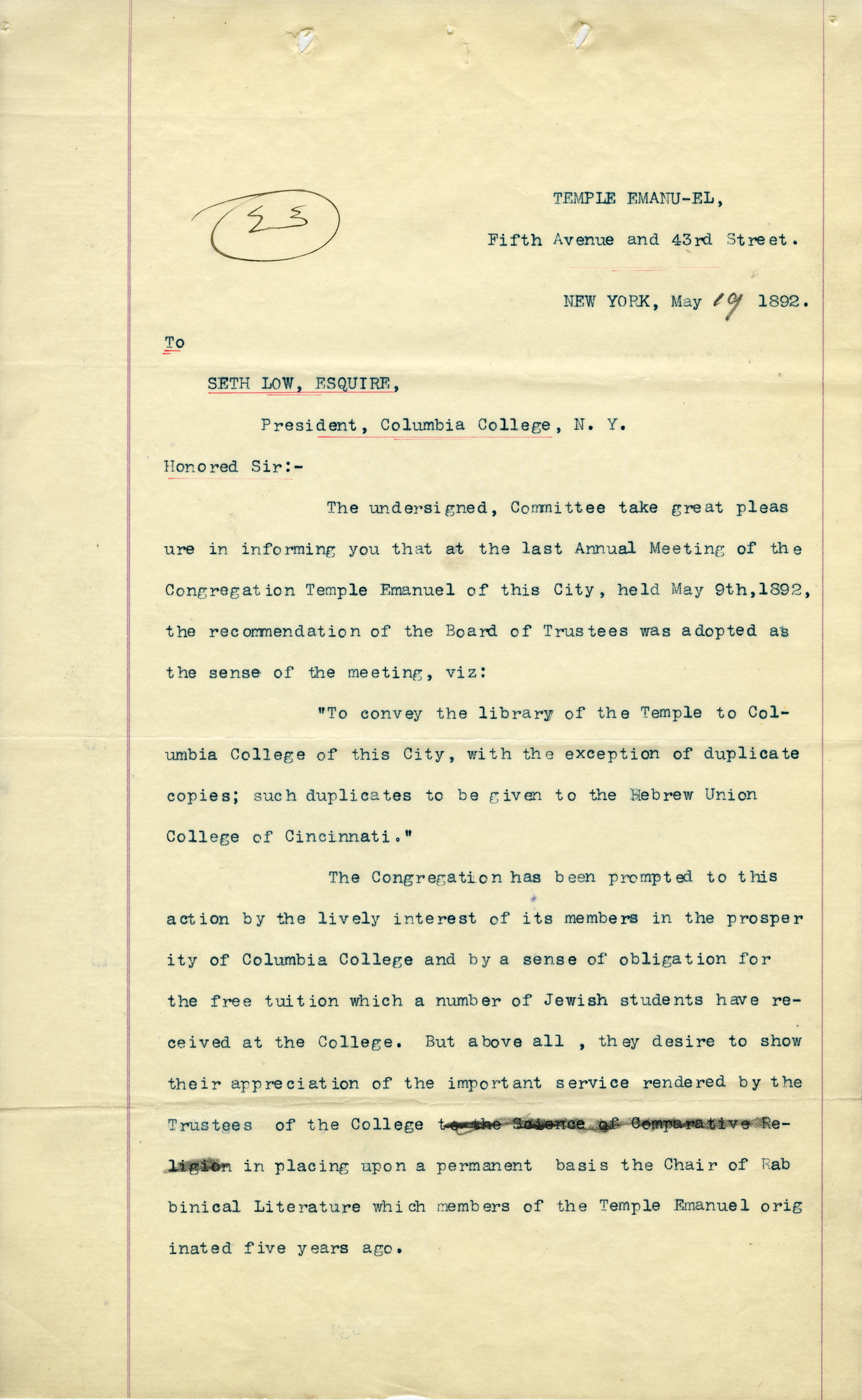
Letter Regarding the Donation of the Library
Temple Emanu-el to Seth Low, May 19, 1892, Letter from synagogue officials offering the library…
- Collection
- Columbia College Papers, Box 67, University Archives
Along with teaching, Gottheil played a crucial role in expanding Columbia’s library resources. In the late 19th century, he arranged for the transfer of the Temple Emanu-El collection—a collection of more than 2,500 volumes and dozens of manuscripts, some dating back to the 1400s—to the university. Initially assembled by an Amsterdam bookseller, the collection became one of the richest Jewish library collections in the United States at the time and an invaluable resource to the budding Jewish studies at the university. It included liturgical manuscripts, rabbinic commentaries, responsa literature, and philosophical works from all over the Jewish diaspora. The collection also included Babylonian tablets, a rarity in a collection of its kind. These tablets allowed students of ancient Assyrian to directly study ancient artifacts, rather than having to consult photographs or descriptions.
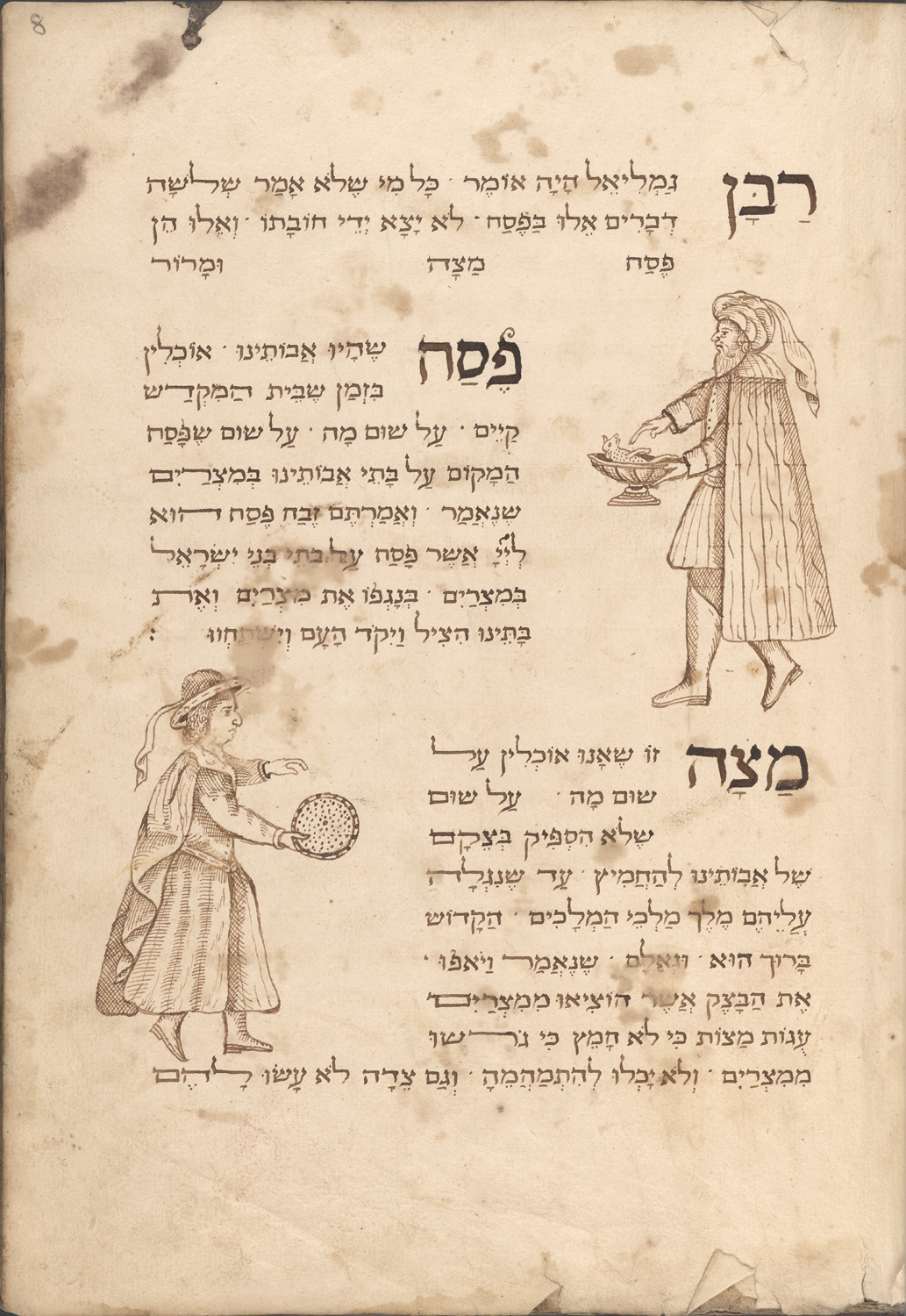
Comtat Venaissin
Prayers for Rosh Ha-Shana and Haggadah for Passover, Carpentras, 18th century
- Collection
- MS X893C J55 v.11
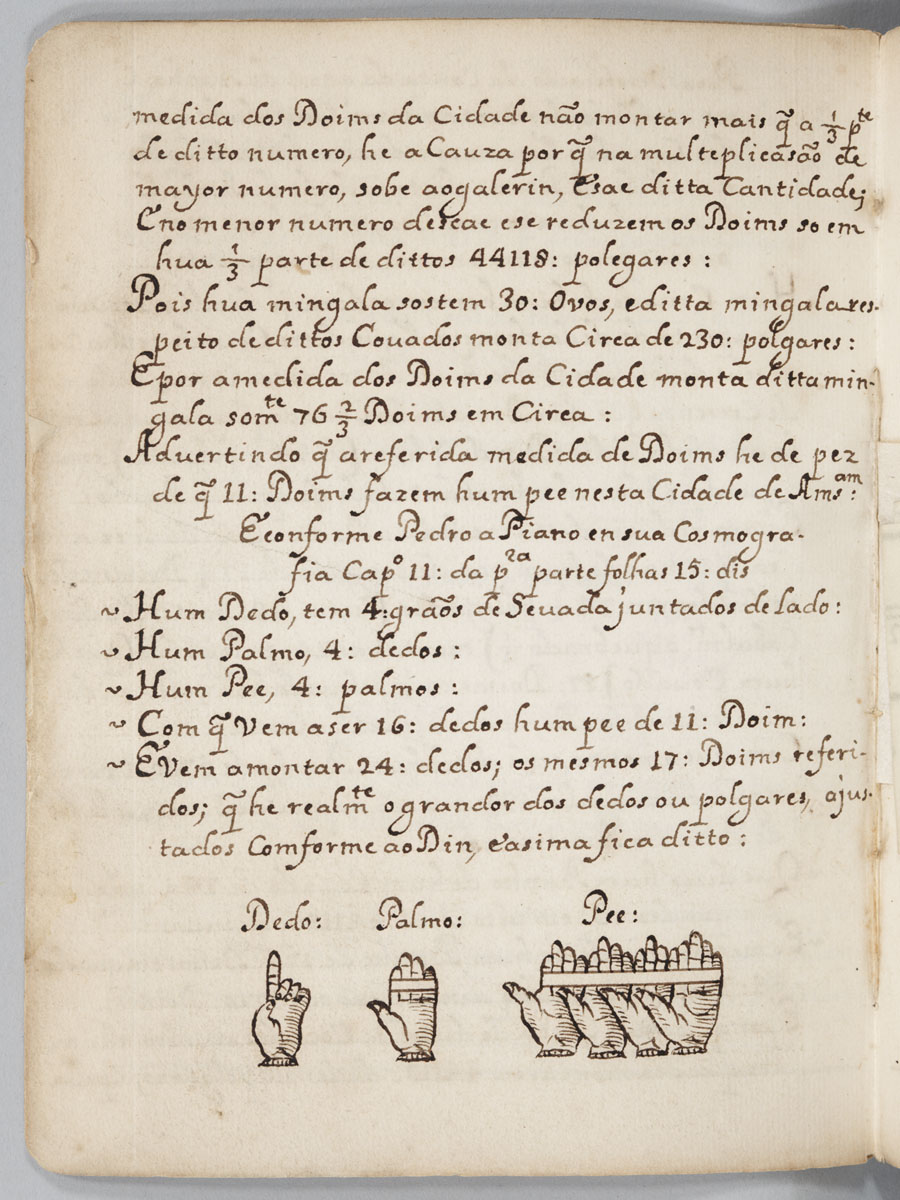
Mikveh
Mikveh (On the Ritual Bath), Amsterdam, 1685
- Collection
- MS X893 Ab7